
Relationship and Marriage Counselling Online for the UK
Relationship and marriage counselling by video for couples and individuals in the UK, with Dr. (Hon.) Taanya Nagi — a counsellor trained and certified in Australia, holding an MA in Counselling Psychology, a Diploma in Holistic Healing a...
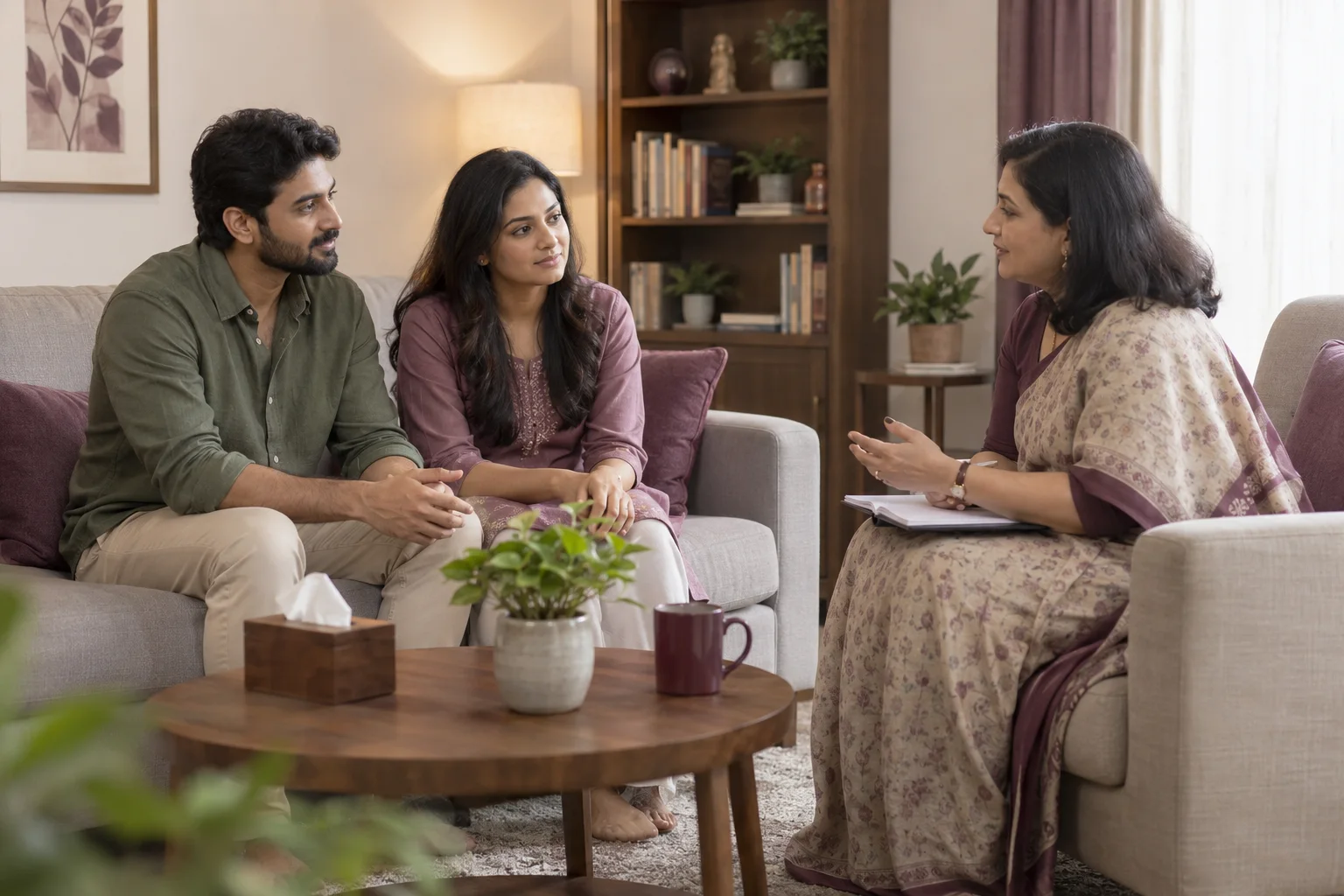
“Relationship and marriage counselling by video for couples and individuals in the UK, with Dr. (Hon.) Taanya Nagi — a counsellor trained and certified in Australia, holding an MA in Counselling Psychology, a Diploma in Holistic Healing and Counselling from the Holistic Living Training Institute (HLTI) in Melbourne and certified membership of the Australian Holistic Healers and Counsellors Association (AHHCA), with certifications in pre-marital and marriage counselling and more than twenty-five years of practice, thirteen of them in Australia. She works from her practice in New Delhi.”
A large share of the UK couples seen here are British Indian or cross-cultural, and that is usually the specific reason they get in touch: the arguments have a cultural architecture that is tiring to explain from scratch, and Taanya understands the Indian family context — in-laws, izzat, money going home, what a marriage means to the wider family — without needing it explained. Joint or individual sessions, in English or Hindi, at UK daytime and weekend times.
Relationship and Marriage Counselling Online for the UK
Training and Credentials
Taanya holds a BA (Hons) in Behavioural Sciences and an MA in Counselling Psychology, and certificates in Pre-Marital Counselling and Marriage and Relationship Counselling. Her Diploma in Holistic Healing and Counselling from HLTI Melbourne is Australian accredited and qualifies her as a certified member of the AHHCA; her Anger and Stress Management certification is from the Australian Institute of Management. She is also a certified Clinical Hypnotherapist, an NLP Practitioner and Life Coach, and a Usui Reiki Master.
She has been counselling for over twenty-five years, lived and practised in Australia for thirteen of them, and still visits Australia and Dubai for training and workshops. Having built a life in a Western country with an Indian family behind her, she brings both perspectives into the room — which for cross-cultural and diaspora couples is the point.
Coming Together, or Alone
Both are ordinary. Joint sessions with both partners on one screen are the usual arrangement and there is something useful in the shared frame — you are literally sitting together, facing the same person.
Individual work on a relationship is equally valid, and frequently more realistic, because one partner is willing before the other is. You do not need both people in the room to change how a relationship runs; you need one person who changes what they do inside it.
Where only one partner attends, the absent one is not treated as a case to be diagnosed in their absence. That would be neither fair nor useful.
What Couples Bring
- The same argument recurring in different forms and never resolving
- In-laws, and where the boundary sits — particularly where parents live with the couple
- Intimacy that has faded and become impossible to raise
- Trust after an affair, a lie, or a long omission
- Money, including supporting relatives in India and the disagreements about it
- Parenting, especially where one partner wants a more Indian upbringing than the other
- Marriages arranged by families where the couple never built a friendship underneath
- Growing apart quietly, with no incident and nobody at fault
Cross-Cultural Couples
Where one partner is British Indian and the other is not, the surface argument is frequently not the real one. How much say parents have in a couple's decisions, whether obligation is a burden or simply a given, how openly disagreement is voiced, how much of family life stays private — these vary enormously, and each partner tends to assume their version is simply how things are.
The work is not usually about deciding whose culture prevails. It is about making the assumptions visible, because two people arguing from unexamined premises land back in the same place every time.
The same applies where both partners are Indian-origin but were raised in different countries — one in India, one in Britain. That gap is subtler and often more frustrating precisely because both assume they are starting from the same place.
The Izzat Problem
British Indian couples frequently describe a specific pressure: a marriage in difficulty is not treated as a private matter but as something with consequences for the wider family's standing, and for unmarried siblings' prospects.
This is one of the main reasons couples delay seeking help for years, and one of the main reasons some couples remain in marriages that have become genuinely harmful. It gets named in the room, because a couple managing both the marriage and everyone's opinion of the marriage is carrying two problems and usually only discussing one.
Where Counselling Is Not Appropriate
Joint counselling is not appropriate where there is violence or coercive control. Joint sessions that encourage honest disclosure can raise the risk to the person in danger after they go home.
If that is your situation, individual support is available. In the UK, the National Domestic Abuse Helpline is free on 0808 2000 247, twenty-four hours. In immediate danger, call 999.
Timing
India is four and a half hours ahead of the UK in summer and five and a half in winter. UK daytime and early-afternoon sessions are the easiest to arrange, and weekend mornings work well for couples who both work.
Sessions run an hour. Where you are in the same house, both partners on one screen in one room works better than two devices in two rooms.
How This Works
Sessions are held online by video from the practice at D-96 Anand Niketan, New Delhi. There is no UK consulting room; UK clients are seen online only.
Counselling is not statutorily regulated in the UK. Taanya is not on the BACP, UKCP or NCPS voluntary registers and is not HCPC-registered; she practises as a counselling psychologist in India on the strength of her MA, and because that title is protected in the UK she works with UK clients as a counsellor and clinical hypnotherapist. If a UK register and its complaints route matter to you, a UK-registered practitioner is the right choice.
She does not diagnose or prescribe medication. Sessions are paid privately and are not reimbursable through the NHS or UK insurers; Relate and similar UK organisations offer sliding-scale couples counselling if cost is the deciding factor.
This is not a crisis service. Call 999 in an emergency, Samaritans free on 116 123, or the National Domestic Abuse Helpline on 0808 2000 247.
20+
Years
40k+
Lives Touched
20+
Modalities
15+
Countries
Relationship and Marriage Counselling Online for Clients in the UK
Frequently Asked Questions
Everything you need to know before booking your first session.
My partner will not come. Is there any point?+
Yes. A great deal of relationship work is done with one person, and reluctant partners often join later once it is clear the sessions are not a tribunal.
Will you tell us whether to separate?+
No. That is your decision. Counselling can make it a considered decision rather than one taken during the worst week of the year — and some couples use it to separate more decently than they otherwise would.
What are your qualifications for couples work?+
An MA in Counselling Psychology, certificates in Pre-Marital and Marriage and Relationship Counselling, an Australian-accredited Diploma in Holistic Healing and Counselling from HLTI Melbourne, certified membership of the AHHCA, and more than twenty-five years of practice. UK registration is set out under How This Works above.
Can we do sessions if we are in different cities?+
Yes, and it is common where one partner travels. Two devices works fine, though a shared screen is better where you are in the same home.
Can sessions be in Hindi?+
Yes. English or Hindi, or both within one session — and where one partner is more comfortable in one language than the other, that itself is often part of the work.
What if I need urgent help?+
Call 999 in an emergency, Samaritans free on 116 123, or the National Domestic Abuse Helpline on 0808 2000 247.